Python for Everything
1. Introduction
Python is one of the most popular and versatile programming languages in the world. It is widely used in software development, data science, Artificial Intelligence, Machine Learning, web development, automation, computer vision, and many other fields.
One of the main reasons for Python's popularity is its large ecosystem of libraries and frameworks. Developers can combine Python with specialized tools to solve different types of real-world problems.
For example:
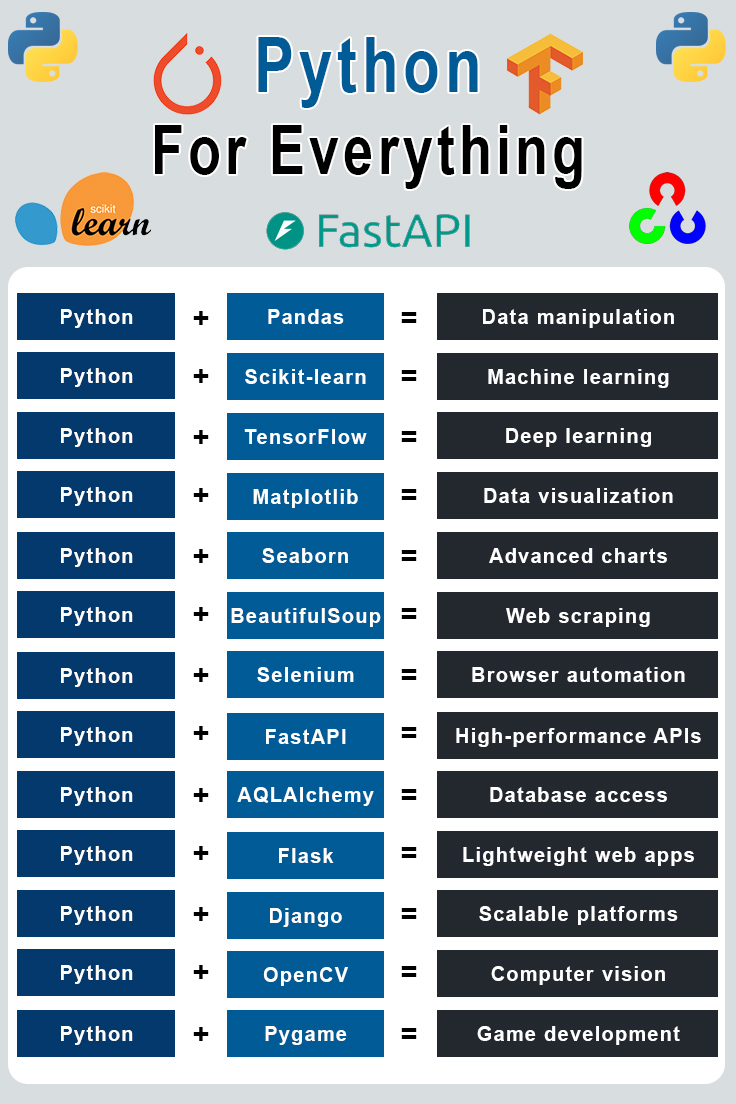
Python + Pandas → Data Manipulation
Python + Scikit-learn → Machine Learning
Python + TensorFlow → Deep Learning
Python + Matplotlib → Data Visualization
Python + Seaborn → Advanced Charts
Python + BeautifulSoup → Web Scraping
Python + Selenium → Browser Automation
Python + FastAPI → High-Performance APIs
Python + SQLAlchemy → Database Access
Python + Flask → Lightweight Web Applications
Python + Django → Scalable Web Platforms
Python + OpenCV → Computer Vision
Python + Pygame → Game Development
This makes Python a powerful general-purpose language that can be used for many different applications.
2. Python + Pandas = Data Manipulation
Pandas is one of the most widely used Python libraries for working with structured data.
It provides useful data structures such as DataFrames and Series that make it easier to load, clean, transform, filter, and analyze datasets.
Common Applications
Reading CSV and Excel files
Cleaning datasets
Filtering data
Sorting data
Grouping and aggregating data
Preparing data for Machine Learning
Example:
import pandas as pd

data = {
    "Name": ["John", "Alice", "David"],
    "Score": [85, 92, 78]
}

df = pd.DataFrame(data)

print(df)
3. Python + Scikit-learn = Machine Learning
Scikit-learn is a popular Python library for Machine Learning.
It provides implementations of many algorithms for classification, regression, clustering, preprocessing, and model evaluation.
Common Applications
House price prediction
Student score prediction
Sentiment analysis
Customer classification
Fraud detection
Recommendation systems
Popular algorithms include:
Linear Regression
Logistic Regression
Decision Trees
Random Forest
K-Nearest Neighbors
Support Vector Machines
K-Means Clustering
Example:
from sklearn.linear_model import LinearRegression

model = LinearRegression()

model.fit(X, y)

prediction = model.predict(new_data)
4. Python + TensorFlow = Deep Learning
TensorFlow is a popular framework for building and training Deep Learning models.
It can be used to create neural networks that learn complex patterns from large datasets.
Common Applications
Image recognition
Object detection
Speech recognition
Natural Language Processing
Recommendation systems
Deep Learning research
Example:
import tensorflow as tf

model = tf.keras.Sequential([
    tf.keras.layers.Dense(64, activation="relu"),
    tf.keras.layers.Dense(1)
])
5. Python + Matplotlib = Data Visualization
Matplotlib is a Python library used to create charts and graphs.
It helps developers and data scientists understand data visually.
Common Charts
Line charts
Bar charts
Scatter plots
Histograms
Pie charts
Example:
import matplotlib.pyplot as plt

x = [1, 2, 3, 4]
y = [10, 20, 15, 30]

plt.plot(x, y)
plt.xlabel("X")
plt.ylabel("Y")
plt.show()
6. Python + Seaborn = Advanced Charts
Seaborn is a statistical data visualization library built on top of Matplotlib.
It provides convenient functions for creating informative statistical charts.
Common Applications
Statistical visualization
Correlation analysis
Distribution plots
Heatmaps
Data exploration
Example:
import seaborn as sns

sns.heatmap(data.corr(), annot=True)
Seaborn is especially useful when exploring relationships between multiple variables in a dataset.
7. Python + BeautifulSoup = Web Scraping
BeautifulSoup is a Python library commonly used to extract information from HTML and XML documents.
It can help developers collect publicly available information from web pages.
Common Applications
Extracting article information
Collecting product information
Reading website content
Data collection
HTML parsing
Example:
from bs4 import BeautifulSoup

soup = BeautifulSoup(html, "html.parser")

title = soup.title.text

print(title)
Web scraping should always respect the target website's terms, robots rules, and applicable laws.
8. Python + Selenium = Browser Automation
Selenium is commonly used to automate web browsers.
It allows Python programs to interact with web pages similarly to a human user.
Common Applications
Automated testing
Browser automation
Form testing
Repetitive browser tasks
Web application testing
Example:
from selenium import webdriver

driver = webdriver.Chrome()

driver.get("https://example.com")
9. Python + FastAPI = High-Performance APIs
FastAPI is a modern Python framework for building APIs.
It is commonly used to create backend services for web applications, mobile applications, and AI systems.
Common Applications
REST APIs
AI APIs
Machine Learning model APIs
Mobile application backends
Microservices
Example:
from fastapi import FastAPI

app = FastAPI()

@app.get("/")
def home():
    return {"message": "Hello World"}
FastAPI is especially useful when building modern Python-based backend services.
10. Python + SQLAlchemy = Database Access
SQLAlchemy is a Python SQL toolkit and Object Relational Mapper (ORM).
It allows developers to work with relational databases using Python.
Common Applications
Database operations
Creating database models
Querying data
Managing relationships
Building backend applications
It can work with databases such as PostgreSQL, MySQL, and SQLite.
Example:
from sqlalchemy import create_engine

engine = create_engine("sqlite:///example.db")
11. Python + Flask = Lightweight Web Applications
Flask is a lightweight Python web framework.
It is simple to learn and is suitable for building small to medium-sized web applications and APIs.
Common Applications
Web applications
REST APIs
Prototypes
Small backend services
Internal tools
Example:
from flask import Flask

app = Flask(__name__)

@app.route("/")
def home():
    return "Hello World"
12. Python + Django = Scalable Web Platforms
Django is a powerful Python web framework designed for building secure and scalable web applications.
It provides many built-in features, including URL routing, authentication, database integration, administration tools, and security features.
Common Applications
Business applications
Content management systems
E-commerce platforms
Social platforms
Large web applications
Django is a good choice when developers need a feature-rich web framework.
13. Python + OpenCV = Computer Vision
OpenCV is a popular computer vision library that can be used with Python to process and analyze images and videos.
Common Applications
Face detection
Object detection
Image processing
Video analysis
Image classification
Motion detection
Example:
import cv2

image = cv2.imread("image.jpg")

cv2.imshow("Image", image)
cv2.waitKey(0)
cv2.destroyAllWindows()
14. Python + Pygame = Game Development
Pygame is a Python library designed for creating games and multimedia applications.
It provides tools for handling graphics, sound, keyboard input, mouse input, and game loops.
Common Applications
2D games
Educational games
Interactive applications
Game prototypes
Example:
import pygame

pygame.init()

screen = pygame.display.set_mode((800, 600))

pygame.display.set_caption("My Game")
15. Python Ecosystem at a Glance
Python Library / FrameworkMain PurposePandasData ManipulationScikit-learnMachine LearningTensorFlowDeep LearningMatplotlibData VisualizationSeabornAdvanced ChartsBeautifulSoupWeb ScrapingSeleniumBrowser AutomationFastAPIHigh-Performance APIsSQLAlchemyDatabase AccessFlaskLightweight Web AppsDjangoScalable Web PlatformsOpenCVComputer VisionPygameGame Development
16. Why Python Is So Popular
Python has become one of the most widely used programming languages because of its simplicity, readability, and extensive ecosystem.
Major Advantages
Easy-to-understand syntax
Large number of libraries
Large developer community
Useful for beginners and professionals
Cross-platform support
Strong Machine Learning and AI ecosystem
Suitable for rapid development
Can be used for both small and large projects
Python can also be integrated with other technologies and programming languages when high performance or specialized functionality is required.
17. Real-World Applications
Python is used in many industries and areas, including:
Artificial Intelligence
Python is widely used to build AI and Machine Learning systems.
Data Science
Libraries such as Pandas, NumPy, Matplotlib, and Seaborn help developers analyze and visualize data.
Web Development
Frameworks such as Django, Flask, and FastAPI are used to build websites, APIs, and backend systems.
Automation
Python can automate repetitive tasks, data processing, testing, and browser-based workflows.
Computer Vision
OpenCV allows developers to build applications that understand and process images and videos.
Game Development
Pygame provides tools for creating 2D games and interactive applications.
Backend Development
FastAPI, Flask, and Django can be used to create powerful backend services and APIs.
18. Conclusion
Python is more than just a programming language. Its large ecosystem allows developers to solve problems across many different areas.
With Pandas, Python becomes a powerful tool for data manipulation. With Scikit-learn, it can be used for Machine Learning. With TensorFlow, it supports Deep Learning. Libraries such as Matplotlib and Seaborn make data visualization easier, while BeautifulSoup and Selenium support web data extraction and browser automation.
For backend development, frameworks such as FastAPI, Flask, and Django provide different approaches for building APIs and web applications. OpenCV extends Python into computer vision, while Pygame can be used for game development.
Because of this wide range of libraries and frameworks, Python can be used in almost every major area of modern software development, making it a powerful and flexible language for both beginners and experienced developers.