
SQL Joins
1. Introduction
SQL Joins are one of the most important concepts in SQL (Structured Query Language). They are used to combine related data from two or more tables in a database. In a relational database, information is usually divided into multiple tables to avoid duplication and keep the data organized. However, when we need information from different tables at the same time, SQL Joins allow us to connect those tables using a common column.
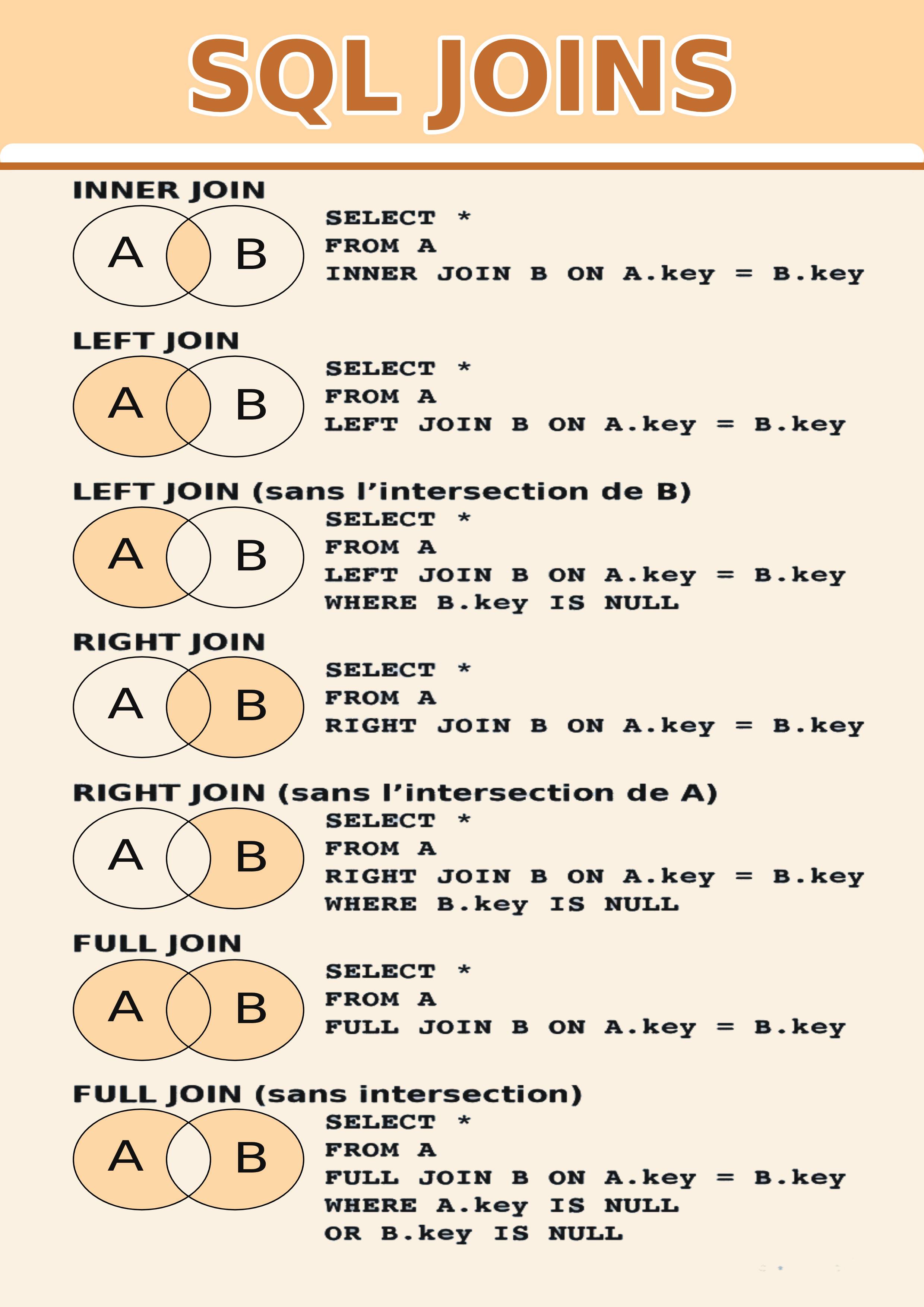
For example, consider a database containing two tables: Students and Courses. The Students table may contain student information such as student ID and name, while the Courses table may contain course information and the student ID associated with each course. Using a SQL Join, we can combine these tables and retrieve the student's name along with their course information. The image illustrates several common types of SQL Joins using Venn diagrams. The highlighted areas represent the records that are
returned by each type of join.
2. Why SQL Joins Are Used
SQL Joins are useful when related information is stored in separate tables. Instead of storing all information in one large table, databases can divide information into smaller and more organized tables.
For example:
Customers table stores customer details.
Orders table stores order details.
Products table stores product information. Using SQL Joins, we can combine these tables to answer questions such as:
Which customer placed each order?
What products were included in an order?
This makes SQL Joins essential for database management, reporting, data analysis, and application development.
3. INNER JOIN
An INNER JOIN returns only the records that have matching values in both tables.
SELECT *
FROM A
INNER JOIN B
ON A.key = B.key;
If a record exists in both Table A and Table B with the same key, that record will be included in the result. Records that do not have a match are excluded.
Example: If Table A contains 10 customers and Table B contains orders for only 7 of those customers, an INNER JOIN will return information for those 7 matching customers.
4. LEFT JOIN
A LEFT JOIN returns all records from the left table and the matching records from the right table.
SELECT *
FROM A
LEFT JOIN B
ON A.key = B.key;
If a record from Table A does not have a matching record in Table B, the columns from Table B will contain NULL values. This is useful when we want to keep every record from the main table, even if related information does not exist.
5. RIGHT JOIN
A RIGHT JOIN works in the opposite way of a LEFT JOIN. It returns all records from the right table and matching records from the left table.
SELECT *
FROM A
RIGHT JOIN B
ON A.key = B.key;
If a record in Table B does not have a matching record in Table A, the columns from Table A will contain NULL values. RIGHT JOIN is less commonly used than LEFT JOIN because the same result can often be achieved by changing the order of the tables and using a LEFT JOIN.
6. FULL JOIN
A FULL JOIN, also called a FULL OUTER JOIN, returns all records from both tables.
SELECT *
FROM A
FULL JOIN B
ON A.key = B.key;
Matching records are combined, while records that exist only in one table are also included. Missing values are represented using NULL. This type of join is useful when we need to see all records from both tables, regardless of whether they have a matching record.
7. Conclusion
SQL Joins provide a powerful way to retrieve and combine related information from multiple database tables. The most commonly used joins are INNER JOIN, LEFT JOIN, RIGHT JOIN, and FULL JOIN. Each join works differently depending on which records we want to include.
Understanding SQL Joins is essential for anyone working with databases, backend development, data analysis, or software applications. By choosing the correct type of join, we can efficiently retrieve meaningful information from related tables without storing duplicate data.
The Venn diagrams in the image provide a simple visual way to understand how each join works. Once these concepts are understood, developers can use SQL Joins to perform more advanced queries and generate useful reports from relational databases.